Henley:Eship

From EVOCD
Revision as of 12:07, 14 June 2013 by Henley (Talk | contribs)

(diff) ← Older revision | Latest revision (diff) | Newer revision → (diff)
Jump to: navigation, search

(From Angie's notes)

Contents

Definitions

P: \mbox{Power in kW}
pf: \mbox{power factor (value 0-1)}
S: \mbox{Apparent Power kVA}
V_{ll} : \mbox{line-to-line Voltage}
I_{line} : \mbox{line current in Amps}
\left | \bar{I} \right | : \mbox{Available Cable Ampacity}
 \phi : \mbox{phase}
 f : \mbox{system input frequency in Hz}
 \bar{Z} : \mbox{Impedance (complex)}
 r_0 : \mbox{conductor radius in m (inner r)}
 r_1 : \mbox{conductor + insulation radius in m (inner r + insulation)}
 r_2 : \mbox{conductor + insulation + sheath radius in m (inner r + insulation + sheath)}
 \mu_r : 1 \mbox{ (for copper)}
 \epsilon_r : 2.7 \mbox{ simulink constant (for copper)}
tandelta: 0.0016 \mbox{ tangent of } \delta
 l : \mbox{length of cable}
R: \mbox{Resistance}
L: \mbox{Inductance}
C: \mbox{Capacitance}
G: \mbox{Conductance}
X: \mbox{Reactance}
X_L: \mbox{Inductive Reactance}
X_C: \mbox{Capacitive Reactance}

Equations

S = \frac{P}{pf}


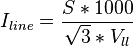
I_{line} = \frac{S * 1000}{\sqrt{3} * V_{ll}}

Note: For AC, most loads are 3\phi, thus 3 "lines". For DC, +conductor and -conductor, thus 2 "lines".
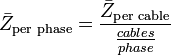
\bar{Z}_\text{per phase} = \frac{\bar{Z}_\text{per cable}}{\frac{cables}{phase}}

Find Total Cables

  1. Compute I_{line} using above equations.
  2. From a Look Up Table [or from S3D catalog], Find the cable with closest size AvailableCableAmpacity.

  3. Compute cables per phase with the formula \frac{cables}{phase} = \left \lceil \frac{I_{line}}{AvailableCableAmpacity} \right \rceil

  4. Compute TotalCables = \frac{cables}{phase} * NumberOfPhases


Find Impedance per cable (\bar{Z}_\text{per cable})

  1. From cable selected above, use lookup tables [or S3D catalog] to get area in mm^2, insulation thickness in mm, and sheath thickness in mm.
  2. Compute r_0 = \frac{\sqrt{\frac{Area(mm^2)}{\pi}}}{1000}
  3. Compute r_1 = \frac{Insulation thickness(mm)+\sqrt{\frac{Area(mm^2)}{\pi}}}{1000}
  4. Compute r_2 = \frac{Sheath thickness(mm)+Insulation thickness(mm)+\sqrt{\frac{Area(mm^2)}{\pi}}}{1000}
  5. Compute \mu = (\mu_r)(4\pi)(1e^-7)
  6. Compute \epsilon = (\epsilon_r)(8.854e^-12)
  7. Compute \omega = 2\pi f
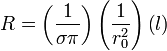
  8. Compute R = \left( \frac{1}{\sigma\pi} \right) \left( \frac{1}{r_0^2} \right) \left( l \right)
  9. Compute L = \left( \frac{\mu}{2\pi} \right) \left( \ln \left(\frac{r_1}{r_0} \right) \right) \left( l \right)
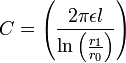
  10. Compute C = \left( \frac{ 2 \pi \epsilon l}{ \ln \left(\frac{r_1}{r_0} \right) } \right)
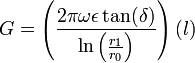
  11. Compute G = \left( \frac{2 \pi \omega \epsilon \tan(\delta)}{ \ln \left(\frac{r_1}{r_0} \right)} \right) \left( l \right)
  12. Compute \bar{Z}_\text{per cable} = \left[ \frac{R}{2} + j \frac{L\omega}{2} \right] + 
\left[ \frac{1}
{\left[ (G + j C\omega) + \frac{1}{\left( \frac{R}{2} + j\frac{L\omega}{2} \right)} \right]}
\right]

Alternatively (if R,L,C are known):

  1. Compute X_L = j \omega L
  2. Compute X_C = j \frac{1}{\omega C}
  3. Compute X = X_L - X_C
  4. Compute \bar{Z}_\text{per cable} = R + jX


ToDo

  • Need to compute bending radius per phase from bending radius per cable. (Angie is going to check with Mike on what to do for this.)


Personal tools
Namespaces

Variants
Actions
home
Materials
Material Models
Design
Resources
Projects
Education
Toolbox