Getting started for new users
(c.f. general information on the material models at the electronic scale)
Download Quantum Espresso here.
Input files required to run Quantum Espresso
To run Quantum Espresso, all you need is an input file and a pseudopotential and an input script.
Here is an example input script: File:Qe.input.txt
How to run Quantum Espresso
Sample Run with Aluminum
This input file was run using Quantum Espresso using the command assuming that the input file name is 'al.in'
pw.x <scf.in> scf.out& (using only one processor)
mpirun -np 4 pw.x <al.in> al.out (using 4 processors)
In the below input file, the directory to pseudopotentials need to be specified (in this case LDA pseudopotential, Al.pz-n-rrkjus_psl.0.1.UPF is used )Download here.
 &CONTROL
                 calculation = 'scf' ,
                      outdir = './tmp' ,
                  pseudo_dir = 'dir/to/pseudopotentials' ,
                      prefix = 'pwscf' ,
                   verbosity = 'low' ,
 /
 &SYSTEM
                       ibrav = 2,
                   celldm(1) = 7.6525971195,
                         nat = 1,
                        ntyp = 1,
                     ecutwfc = 30 ,
                     ecutrho = 120 ,
                 occupations = 'smearing' ,
                     degauss = 0.005 ,
                    smearing = 'marzari-vanderbilt' ,
 /
 &ELECTRONS
                    conv_thr = 1d-06 ,
                 mixing_beta = 0.7d0 ,
 /
ATOMIC_SPECIES
   Al   26.98150  Al.pz-n-rrkjus_psl.0.1.UPF
ATOMIC_POSITIONS crystal
   Al      0.000000000    0.000000000    0.000000000
K_POINTS automatic
  8 8 8   0 0 0
|
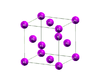 Structure of Aluminum visualized using Xcrysden [ [1]].
The ouput file al.out looks like this
     Program PWSCF v.5.1 starts on  4Feb2017 at 19:24:29

     This program is part of the open-source Quantum ESPRESSO suite
     for quantum simulation of materials; please cite
         "P. Giannozzi et al., J. Phys.:Condens. Matter 21 395502 (2009);
          URL http://www.quantum-espresso.org",
     in publications or presentations arising from this work. More details at
     http://www.quantum-espresso.org/quote

     Parallel version (MPI), running on     1 processors
     Waiting for input...
     Reading input from standard input

     Current dimensions of program PWSCF are:
     Max number of different atomic species (ntypx) = 10
     Max number of k-points (npk) =  40000
     Max angular momentum in pseudopotentials (lmaxx) =  3

     IMPORTANT: XC functional enforced from input :
     Exchange-correlation      = LDA ( 1  1  0  0 0)
     Any further DFT definition will be discarded
     Please, verify this is what you really want


     Subspace diagonalization in iterative solution of the eigenvalue problem:
     a serial algorithm will be used


     G-vector sticks info
     --------------------
     sticks:   dense  smooth     PW     G-vecs:    dense   smooth      PW
     Sum         241     241     61                 2445     2445     331


     bravais-lattice index     =            2
     lattice parameter (alat)  =       7.6526  a.u.
     unit-cell volume          =     112.0383 (a.u.)^3
     number of atoms/cell      =            1
     number of atomic types    =            1
     number of electrons       =         3.00
     number of Kohn-Sham states=            6
     kinetic-energy cutoff     =      30.0000  Ry
     charge density cutoff     =     120.0000  Ry
     convergence threshold     =      1.0E-06
     mixing beta               =       0.7000
     number of iterations used =            8  plain     mixing
     Exchange-correlation      = LDA ( 1  1  0  0 0)

     celldm(1)=   7.652597  celldm(2)=   0.000000  celldm(3)=   0.000000
     celldm(4)=   0.000000  celldm(5)=   0.000000  celldm(6)=   0.000000

     crystal axes: (cart. coord. in units of alat)
               a(1) = (  -0.500000   0.000000   0.500000 )
               a(2) = (   0.000000   0.500000   0.500000 )
               a(3) = (  -0.500000   0.500000   0.000000 )

     reciprocal axes: (cart. coord. in units 2 pi/alat)
               b(1) = ( -1.000000 -1.000000  1.000000 )
               b(2) = (  1.000000  1.000000  1.000000 )
               b(3) = ( -1.000000  1.000000 -1.000000 )


     PseudoPot. # 1 for Al read from file:
     /home/chaitanya/pseudo/Al.pz-n-rrkjus_psl.0.1.UPF
     MD5 check sum: d65347cb939431d5400bc8497a8acd39
     Pseudo is Ultrasoft + core correction, Zval =  3.0
     Generated using "atomic" code by A. Dal Corso  v.5.0.2 svn rev. 9415
     Using radial grid of 1135 points,  4 beta functions with:
                l(1) =   0
                l(2) =   0
                l(3) =   1
                l(4) =   1
     Q(r) pseudized with 0 coefficients


     atomic species   valence    mass     pseudopotential
        Al             3.00    26.98150     Al( 1.00)

     48 Sym. Ops., with inversion, found


   Cartesian axes

     site n.     atom                  positions (alat units)
         1           Al  tau(   1) = (   0.0000000   0.0000000   0.0000000  )

     number of k points=     1  Marzari-Vanderbilt smearing, width (Ry)=  0.0050
                       cart. coord. in units 2pi/alat
        k(    1) = (   0.0000000   0.0000000   0.0000000), wk =   2.0000000

     Dense  grid:     2445 G-vectors     FFT dimensions: (  20,  20,  20)

     Largest allocated arrays     est. size (Mb)     dimensions
        Kohn-Sham Wavefunctions         0.03 Mb     (     331,    6)
        NL pseudopotentials             0.04 Mb     (     331,    8)
        Each V/rho on FFT grid          0.12 Mb     (    8000)
        Each G-vector array             0.02 Mb     (    2445)
        G-vector shells                 0.00 Mb     (      61)
     Largest temporary arrays     est. size (Mb)     dimensions
        Auxiliary wavefunctions         0.12 Mb     (     331,   24)
        Each subspace H/S matrix        0.01 Mb     (      24,   24)
        Each <psi_i|beta_j> matrix      0.00 Mb     (       8,    6)
        Arrays for rho mixing           0.98 Mb     (    8000,    8)

     Check: negative/imaginary core charge=   -0.000006    0.000000

     Initial potential from superposition of free atoms

     starting charge    2.99797, renormalised to    3.00000
     Starting wfc are    4 randomized atomic wfcs +    2 random wfc

     total cpu time spent up to now is        1.8 secs

     per-process dynamical memory:     6.3 Mb

     Self-consistent Calculation

     iteration #  1     ecut=    30.00 Ry     beta=0.70
     Davidson diagonalization with overlap
     ethr =  1.00E-02,  avg # of iterations =  6.0

     Threshold (ethr) on eigenvalues was too large:
     Diagonalizing with lowered threshold

     Davidson diagonalization with overlap
     ethr =  2.50E-04,  avg # of iterations =  4.0

     total cpu time spent up to now is        2.0 secs

     total energy              =      -5.22889740 Ry
     Harris-Foulkes estimate   =      -5.22816742 Ry
     estimated scf accuracy    <       0.00757953 Ry

     iteration #  2     ecut=    30.00 Ry     beta=0.70
     Davidson diagonalization with overlap
     ethr =  2.53E-04,  avg # of iterations =  1.0

     total cpu time spent up to now is        2.0 secs

     total energy              =      -5.22906489 Ry
     Harris-Foulkes estimate   =      -5.22895148 Ry
     estimated scf accuracy    <       0.00065046 Ry

     iteration #  3     ecut=    30.00 Ry     beta=0.70
     Davidson diagonalization with overlap
     ethr =  2.17E-05,  avg # of iterations =  1.0

     total cpu time spent up to now is        2.1 secs

     End of self-consistent calculation

          k = 0.0000 0.0000 0.0000 (   331 PWs)   bands (ev):

    -3.4045  20.1579  20.1579  21.4744  21.4744  21.4744

     the Fermi energy is    20.1412 ev

!    total energy              =      -5.22909765 Ry
     Harris-Foulkes estimate   =      -5.22909744 Ry
     estimated scf accuracy    <       0.00000061 Ry

     The total energy is the sum of the following terms:

     one-electron contribution =       3.18844966 Ry
     hartree contribution      =       0.01500066 Ry
     xc contribution           =      -3.03735564 Ry
     ewald contribution        =      -5.39212484 Ry
     smearing contrib. (-TS)   =      -0.00306748 Ry

     convergence has been achieved in   3 iterations

     Writing output data file pwscf.save

     init_run     :      0.97s CPU      1.15s WALL (       1 calls)
     electrons    :      0.13s CPU      0.24s WALL (       1 calls)

     Called by init_run:
     wfcinit      :      0.01s CPU      0.00s WALL (       1 calls)
     potinit      :      0.01s CPU      0.02s WALL (       1 calls)

     Called by electrons:
     c_bands      :      0.04s CPU      0.09s WALL (       4 calls)
     sum_band     :      0.04s CPU      0.06s WALL (       4 calls)
     v_of_rho     :      0.02s CPU      0.03s WALL (       4 calls)
     newd         :      0.03s CPU      0.04s WALL (       4 calls)
     mix_rho      :      0.00s CPU      0.00s WALL (       4 calls)

     Called by c_bands:
     init_us_2    :      0.01s CPU      0.00s WALL (       9 calls)
     cegterg      :      0.04s CPU      0.08s WALL (       4 calls)

     Called by *egterg:
     h_psi        :      0.02s CPU      0.04s WALL (      17 calls)
     s_psi        :      0.00s CPU      0.02s WALL (      17 calls)
     g_psi        :      0.00s CPU      0.00s WALL (      12 calls)
     cdiaghg      :      0.02s CPU      0.01s WALL (      15 calls)

     Called by h_psi:
     add_vuspsi   :      0.00s CPU      0.00s WALL (      17 calls)

     General routines
     calbec       :      0.00s CPU      0.00s WALL (      21 calls)
     fft          :      0.02s CPU      0.01s WALL (      26 calls)
     fftw         :      0.02s CPU      0.03s WALL (     174 calls)
     davcio       :      0.00s CPU      0.00s WALL (       1 calls)

     Parallel routines
     fft_scatter  :      0.01s CPU      0.00s WALL (     200 calls)

     PWSCF        :     1.52s CPU         2.28s WALL


   This run was terminated on:  19:24:31   4Feb2017

=------------------------------------------------------------------------------=
   JOB DONE.
=------------------------------------------------------------------------------=
|
The total energy can be obtained by usning the command
grep '! total energy' al.out
Another example: Generating a Volume-Energy Curve
|
Description
Source Codes of the Scripts
To see a script click on the link. To download right-click on the link and select "Save Link As".
NOTE: all scripts has been uploaded with .txt extension. When downloading you may want to get rid of it.
By downloading these codes you accept the Mississippi State University's license agreement. Please read the agreement carefully before downloading.
Rasmol source code and documentation for this simply molecular viewer available at rasmol.org
To report bugs, problems or to make comments please use the discussion tab above.
|

